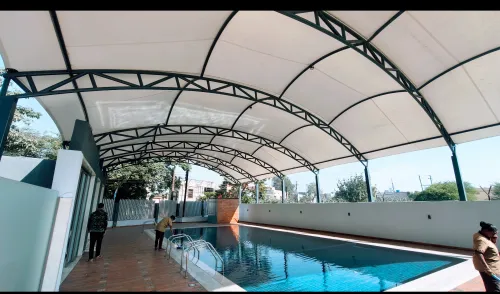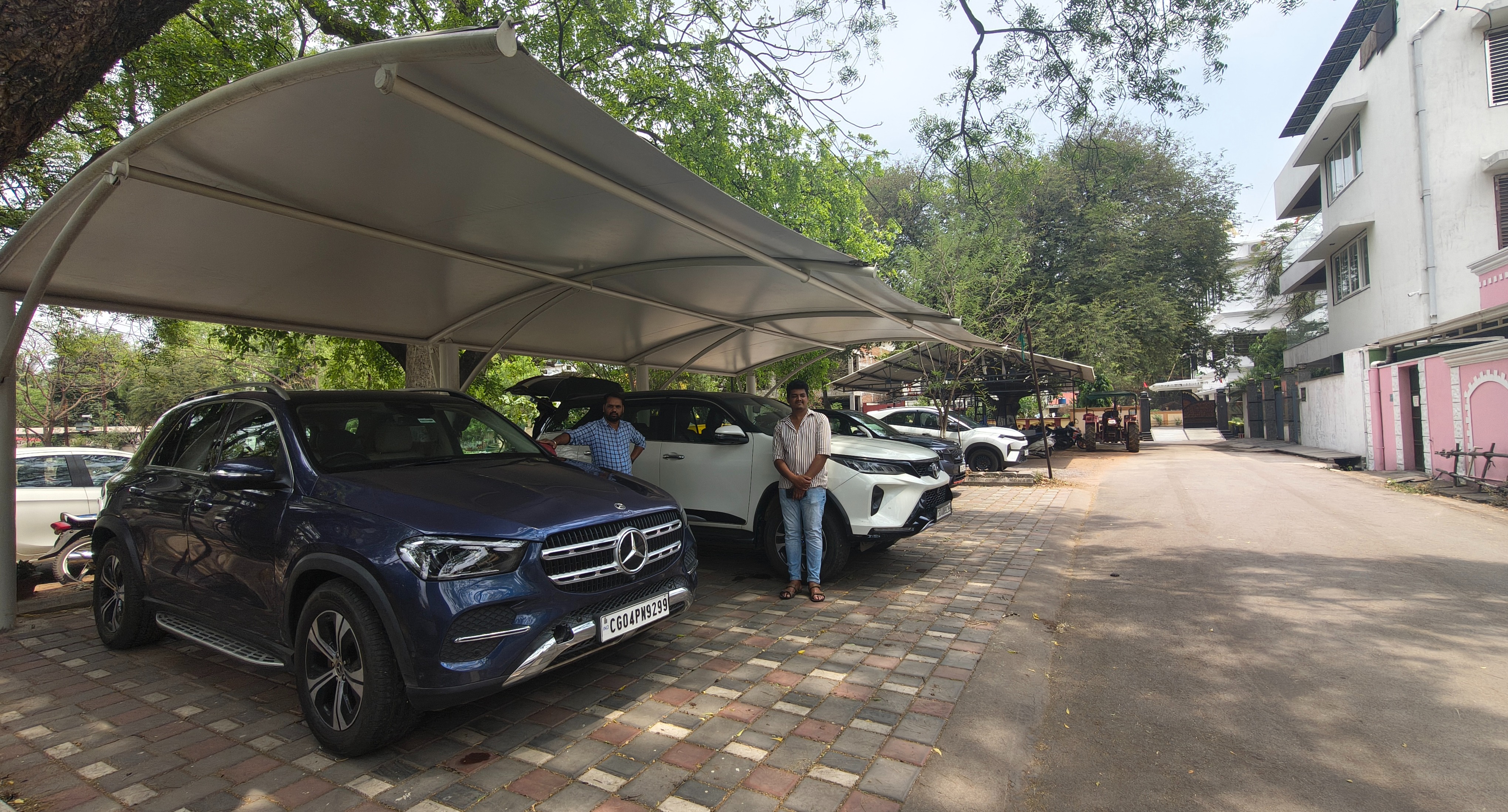
I remember standing on a site in Ambikapur a few months back, watching the clouds gather for a massive monsoon downpour. We were finishing up a watertight commercial canopy, and there's this specific moment of truth when the first few drops hit the fabric. You don't just see the quality; you hear it—or rather, you don’t hear the deafening rattle you’d get with a tin shed. It’s a soft drumming, and everything underneath stays bone-dry.
That project really got me thinking about how much the landscape of construction is changing across East Maharashtra and Chhattisgarh. Lately, we at FV INFRA LLP have been spending a lot of time talking to school administrators and institutional heads who are worried about safety. Specifically in places like Gadchiroli and the forest-rich belts nearby, the logistics of traditional heavy construction are a nightmare. Bringing in massive concrete mixers and heavy steel beams through remote roads? It's expensive and, frankly, overkill for a playground.
The Shift Toward Safety in the "Red Belt"
There is a real reason school roofing in Gadchiroli is leaning toward tensile structures. It isn't just about looking modern—though the "glow" at night is definitely a plus for the local kids. It’s about being earthquake-safe. When you’re responsible for a hundred kids running around a playground, the last thing you want is a heavy, rigid roof overhead if the ground starts to shake.
Our membranes are incredibly lightweight. Because they rely on tension rather than heavy internal pillars, they don't have the same "crush risk" as traditional structures. If we’re installing a safe playground shed, we know that we’re providing a "bioclimatic" shield. It blocks 100% of those nasty UV rays, keeping the assembly area or play zone 10-15 degrees cooler. In the searing heat of Nagpur or Chandrapur, that’s not a luxury; it’s a necessity for the students' health.
Lessons from the Field: From Ambikapur to Titlagarh
Every city teaches us something different. In Ambikapur, we focused on that perfect watertight seal for commercial spaces. But in places like Akola or Amravati, the conversation is always about the wind. The way these fabrics are engineered—whether it’s PVC or PTFE—they handle extreme wind loads that would rip the screws right out of a standard metal sheet.
What I personally love about being a tensile structure manufacturer in this region is the speed. We do all the heavy lifting—the 3D designing and structural drawings—back at the workshop. When we show up at your site in Bhandara, Gondia, or Balaghat, we aren't there for months making a mess. We’re in and out in a few days. The space is clean, the structure is up, and it looks like a piece of art.
Why This Matters for Your Space
If you’ve walked around our completed projects in Raipur, Bilaspur, or Durg, you’ve seen the "freedom of form" I’m talking about. You can’t make concrete look like a wave or a soaring cone. But beyond the aesthetics, it’s the peace of mind. Knowing that a structure in a remote area like Gadchiroli or Kantabanji is self-cleaning (thanks to the rain washing off the dust) means the maintenance staff doesn't have to climb up there every month.
At the end of the day, whether we’re working on a massive stadium in a city or a small school shed in Yavatmal, our goal is the same: building something that lasts 20 years and keeps people safe. We’ve seen enough rusted-out tin roofs and cracked concrete to know that there's a better way to build. It’s why we do what we do at FV INFRA LLP.
If you’re curious about how this would look on your own site—whether you’re in Jagdalpur, Rajnandgaon, or Titlagarh—give us a shout. We usually start with a simple site visit to see what’s actually possible. No pressure, just a real conversation about making your outdoor space actually usable year-round.