I was sitting in a hospital waiting lounge near Durg last month, watching a nurse try to wheel an elderly patient across an open courtyard to the diagnostic wing. A sudden pre-monsoon downpour hit, and within seconds, they were scrambling for cover under a small plastic awning. It struck me right then—we spend crores on high-tech MRI machines and sterile operation theaters, but the actual space where patients and doctors move between buildings is often treated as an afterthought.
In the rapidly expanding healthcare hub along the Nagpur-Raipur corridor, hospital design is finally catching up with global standards. Modern medical campuses aren't just single blocks anymore; they are sprawling complexes. Managing the transition between these buildings is a unique architectural puzzle.
At FV INFRA LLP, we've been working with healthcare administrators to replace those dark, leaking tin corridors with continuous medical campus roofing that completely changes how a hospital breathes.
Why Sterile Environments Need Better Fabric
When a hospital plans an expansion in Bhilai or Durg, the default choice used to be concrete or corrugated sheets. But traditional structures introduce pillars every few meters, blocking ambulance pathways and trapping heavy afternoon heat.
Switching to a lightweight, high-strength patient walkway shade Durg setup fixes these fundamental spatial issues:
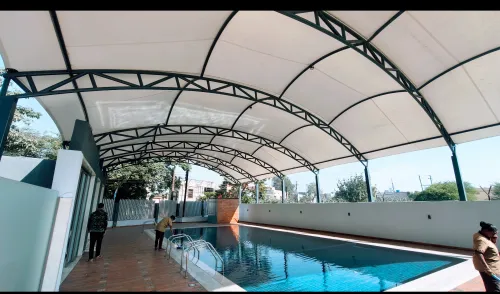
Pillar-Free Mobility: By utilizing tensioned architectural membranes over geometric steel arches, we create wide, clear spans. Wheelchairs, stretchers, and emergency carts can navigate the walkways without dodging structural posts.
The Bioclimatic Advantage: The hospital environment needs to be soothing. Our specialized fabrics block 100% of UV rays and reflect solar radiation. This keeps the outdoor corridors significantly cooler during intense summer months, reducing the thermal shock for patients moving out of air-conditioned wards.
Diffuse Natural Light: The fabric acts as a massive light softener. It fills the walkways with a gentle, calming glow during the day, eliminating the need for constant artificial lighting while looking clean and professional.
The Smart Campus: When Infrastructure Learns to Think
What’s truly transforming hospital infrastructure Bhilai projects right now is the integration of smart tech. We're all familiar with the residential trend where people want to control their living spaces remotely—syncing their devices to say, "Alexa, open the pergola" or expecting their home to lock down automatically when they head to work.
We are bringing that exact philosophy into healthcare architecture. Modern commercial canopies aren't static anymore. We are designing walkways with automated sensors that read the local weather in real-time.
If high winds blow in across Bilaspur or Raipur, or a sudden storm hits Rajnandgaon, the integrated tracking systems can adjust membrane tension or trigger retractable side screens automatically. It ensures that even if the maintenance staff is occupied inside the wards, the outdoor infrastructure is already protecting the campus.
Precision Under Pressure
Building inside an active medical zone requires absolute discipline. You can't have loud concrete mixers and dust clouds near a sterile ICU. Because our structures are prefabricated, the on-site installation is incredibly fast, dry, and clean, wrapping up in just a few days.
We take the engineering behind these lines incredibly seriously. Whether we’re drawing up the initial 3D designing profiles for a facility in Jabalpur, checking structural drawings for an emergency bay in Akola, or shipping materials down to Amravati and Yavatmal, every weld matters.
I remember a project we handled in a crowded corner of Chandrapur where the clearance for emergency vehicles was tight. Seeing our installation crew precision-fit a high-arch tensile structure over the main entry without disrupting a single ambulance run... that’s the kind of complex layout problem that makes our work satisfying.
From the larger institutions in Bhilai to community health centers in places like Ambikapur, Gadchiroli, or Bhandara, we believe healthcare transit spaces should offer dignity and comfort. It’s about building a seamless protective shield so that doctors and patients can focus entirely on recovery, regardless of what the weather is doing outside.