
I was talking to a textile trader in Ambikapur late last year, just as a sudden evening cloudburst hit the market area. Within five minutes, water was pooling on his old tin awning, dripping onto his display racks, and forcing customers to pack up and run for cover. He shook his head, looking at the empty lane, and said, "Every time it rains like this, it’s not just a wet floor—it’s two hours of lost business that I can't get back."
It’s a frustration we see all over the Nagpur-Amravati trading hubs and extending right into Chhattisgarh’s busiest commercial zones. Traditional metal or concrete sheds turn local markets into dark, humid tunnels that leak at the joints and trap heat like an oven during the summer. That’s why our team at FV INFRA LLP has been focused on a different approach: engineering continuous, commercial tensile structure setups that keep the trade moving, no matter what the sky decides to do.
Rethinking the Market Roof: Light, Tight, and Column-Free
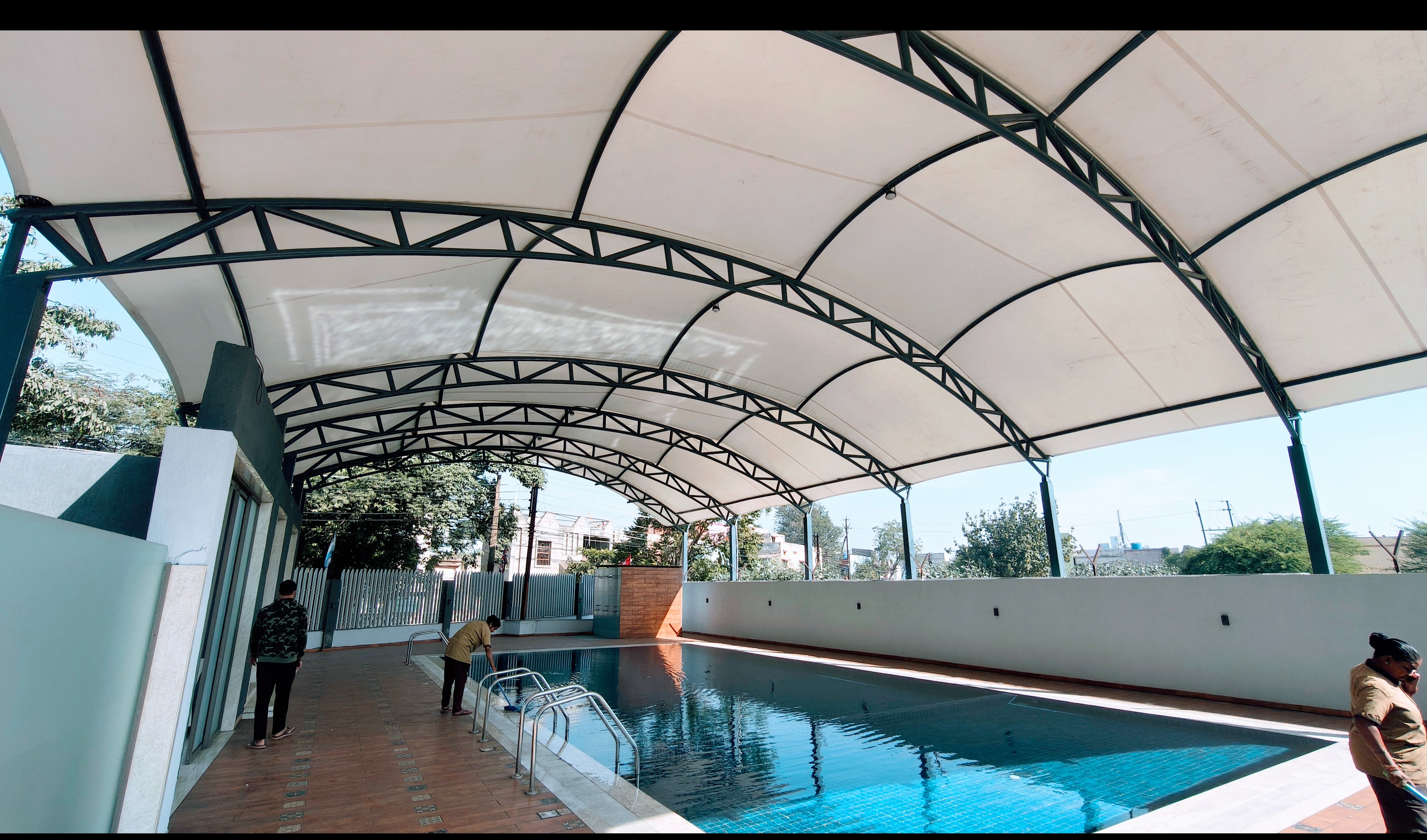
When you walk into a market protected by a modern canopy, the difference hits you instantly. It doesn't look or feel like a factory shed. We use high-strength, flexible membranes stretched over a minimalist steel frame to create a completely seamless, monsoon protection roofing system.
For a busy trader or a shop owner, this shift fixes three major headaches at once:
The Goodbye to Pillars: Because tensile structures rely on continuous tension rather than a grid of heavy columns, we can create a massive market shed Ambikapur merchants can fully utilize. No columns blocking a shop front, no structural posts getting in the way of foot traffic or loading carts.
100% Watertight Pathways: Traditional tin roofs always seem to find a way to leak at the screw holes over time. A tensioned membrane is a single, uninterrupted barrier. Rainwater naturally channels off to the sides into integrated drainage, keeping the walkways completely dry for shoppers.
Natural daylight, Minus the Heat: This fabric is a bit of a bioclimatic marvel. It blocks 100% of harsh UV rays and reflects solar heat, keeping the alleys noticeably cooler in May. Yet, it's naturally translucent, letting a soft, clear daylight filter through so shopkeepers don't have to burn electricity all day just to show off their goods.
The Smart Market: Connecting the Indoors to the Sky
What’s really fascinating is how the concept of a "Connected Home" is spilling over into commercial spaces. We have homeowners asking for automated systems where they can tell their smart assistant to open up a terrace view, or have a canopy slide shut the moment they head out for a shift.
Now, market associations and high-end commercial properties in places like Raipur, Jabalpur, and Bilaspur are looking for that same level of automation. We’ve been integrating smart wind and rain sensors into our structural designs. Imagine a large commercial walkway canopy or a retractable terrace section that senses a sudden storm coming over Akola or Amravati and adjusts its tension or closes completely on its own. It takes the guesswork out of property management and protects public spaces before the first drop even hits the ground.
Built for the Real World
We take the engineering behind these structures deeply personally. From our initial site visits in Yavatmal, Bhandara, and Gondia to the final installation on-site in places like Balaghat, Bhilai, or Durg, we know the local weather doesn't play nice.
I remember a challenging walkway project we took on where the wind loads were particularly tricky due to the alignment of the buildings. Watching our team map out the 3D designing and structural drawing to ensure the steel frame would handle the unique draft, and then seeing that fabric stretch bone-tight... that’s the moment where the hard work pays off. When a storm hits Chandrapur or Gadchiroli a month later and the client calls just to say the market stayed perfectly dry and busy—that's what keeps us going.
Whether we are shipping materials to Titlagarh, Kesinga, and Kantabanji or working on a public space in Ambikapur or Rajnandgao, our goal is to change how communities look at outdoor architecture. A roof shouldn't just be a barrier; it should make a space more alive.