I was standing on a rooftop in Jabalpur last week, looking at a terrace shed that had been installed barely two years ago. The owner was pointing at the polycarbonate sheets, which had turned a sickly, brittle yellow. "It’s like sitting in a greenhouse," he told me. "The heat is unbearable by noon, and the glare actually makes it hard to see your phone screen."
It’s a story we hear constantly at FV INFRA LLP during our site visits across Madhya Pradesh and Maharashtra. People choose polycarbonate because it’s a familiar "quick fix," but they quickly realize that the local climate—where the sun hits like a hammer—is a completely different beast. When we talk about a terrace roofing comparison Jabalpur homeowners need to hear, it isn't just about looks. It’s about not having to replace your entire roof every five years.
The Yellowing Problem vs. The 30-Year Lifespan
Let’s be honest: polycarbonate looks great the day it's installed. It’s clear, it’s shiny, and it’s cheap. But in the Nagpur-Jabalpur belt, the UV radiation is intense. Within 24 months, that plastic starts to break down. It loses its transparency, becomes loud as a drum during the monsoon, and eventually starts to crack along the screw holes.
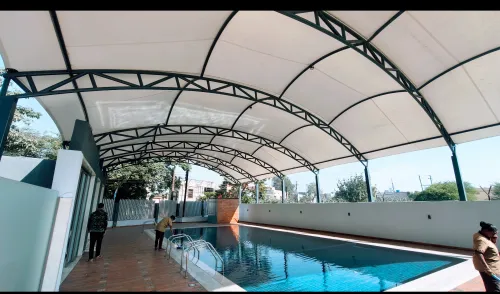
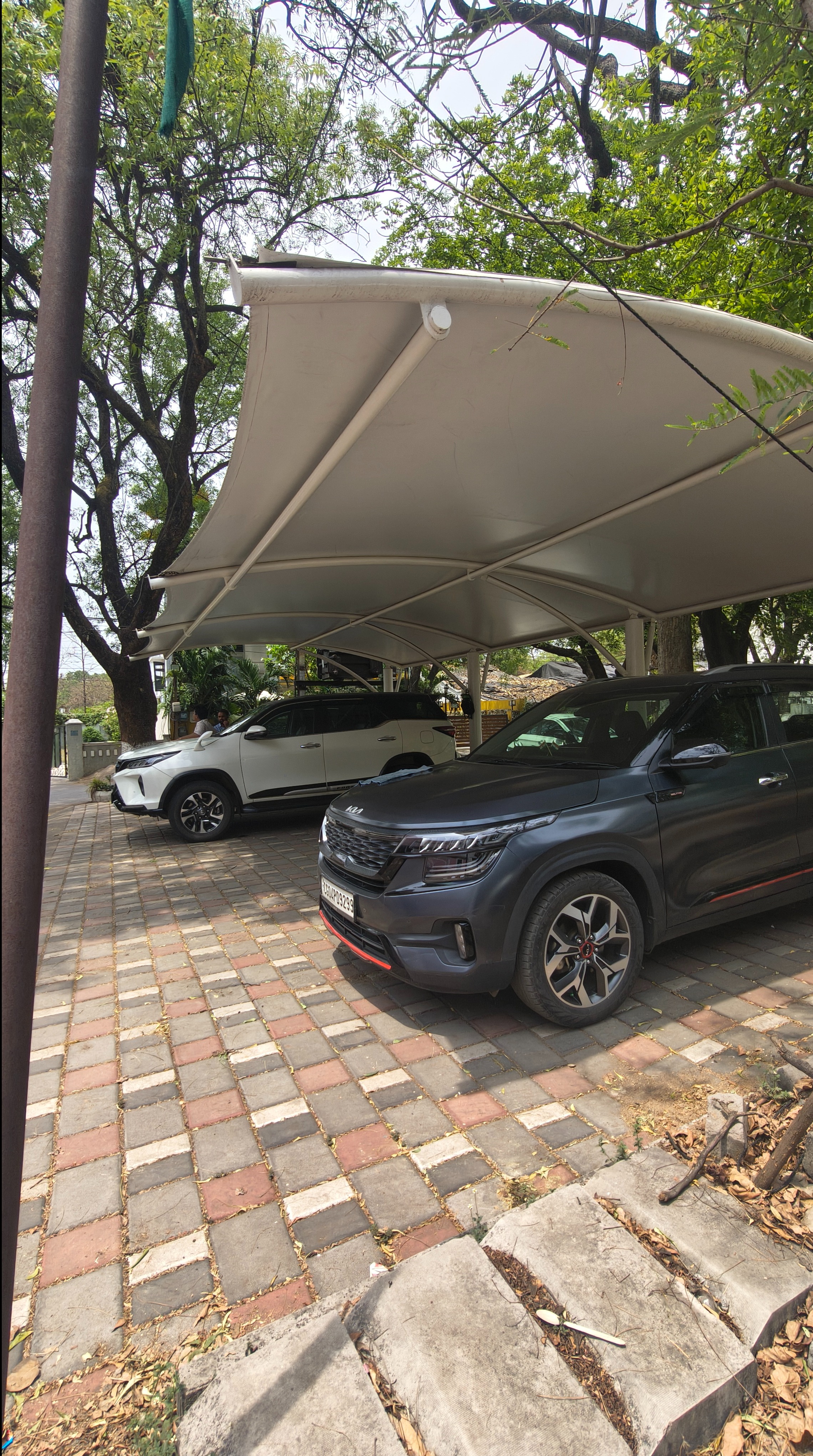
When we design a durable tensile membrane, we’re using materials like PVC or PTFE that are engineered for high-end stadiums and airports. These fabrics don't just "resist" the sun; they reflect it.
UV Blockade: Tensile fabric reflects 100% of UV rays. It doesn't turn yellow because it’s not a rigid plastic—it’s a high-strength flexible membrane.
The Heat Gap: This is the big one. Polycarbonate traps heat underneath it, creating a "greenhouse effect." Tensile fabric acts as a bioclimatic shield, keeping the terrace significantly cooler even when the MP summer is at its peak.
Peace and Quiet: If you’ve ever tried to have a conversation under a polycarbonate roof during a heavy Jabalpur rain, you know it’s impossible. Tensile fabric absorbs the impact of rain, giving you a quiet, sanctuary-like feel instead of a deafening rattle.
The "Invisible Pillar" Advantage
One thing that really gets us excited during the 3D designing phase is showing a client how much space they actually have. Most traditional sheds require a forest of heavy internal pillars to hold up the weight of metal or plastic sheets.
Because tensile structures rely on continuous tension, we can achieve massive "clear-spans." We can cover your entire terrace from edge to edge without a single pillar blocking your view of the Jabalpur skyline. It creates this iconic, "floating" aesthetic that rigid materials just can't mimic.
Our Promise: We handle the whole thing. From the initial site visit and inspection to the structural drawing and final installation on-site. We don’t just drop off materials; we build a space.
A Personal Commitment to the Region
Some projects just stick with you because of the challenge. We recently finished a best terrace shed material installation in Raipur where the wind loads were particularly tricky. We spent extra time on the engineering to ensure that during a storm, that fabric wouldn't just hold—it wouldn't even flutter. Seeing the family finally able to use their terrace for evening tea without worrying about the heat... honestly, that’s what allows our team to sleep at night.