I was walking through a crowded market lane in Gondia last summer, right before the monsoon hit. If you’ve been there, you know the vibe—it’s vibrant, loud, and incredibly busy. But the moment the sun peaks or a sudden cloudburst happens, everyone scrambles. Shopkeepers start pulling out tattered blue tarps, and shoppers vanish into doorways. It’s a mess that honestly kills the local economy for those few hours.
At FV INFRA LLP, we’ve been spending a lot of time lately looking at these "artery" streets in places like Bhandara and Nagpur. We realized that people don’t just want a roof; they want a "connected" experience that makes a busy market feel like a premium plaza.
More Than Just a Plastic Sheet
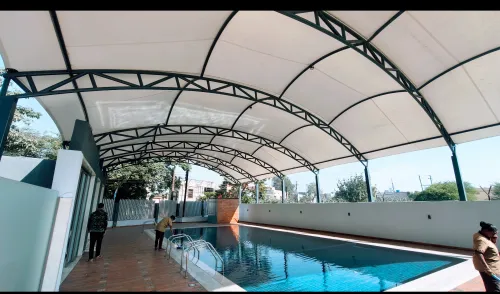
When we talk about a market walkway shed in Gondia, most people picture those heavy, rusty iron sheds that leak at every joint. But the reality is shifting toward something much more intelligent. A modern tensile structure in Bhandara isn't just fabric stretched over steel; it’s a high-durability, bioclimatic tool.
The coolest part? We’re seeing a massive trend where these structures are becoming part of the "Smart City" conversation. Imagine a walkway that doesn't just sit there. We’ve had clients ask about integrating the same tech we use in our luxury pergolas—where lighting and even cooling misters are part of the structure.
[Image: A sleek, white tensile walkway curving through a busy market street]
The "Dry" Shopping Experience
The biggest headache in our region is the transition between seasons. One day it’s 44°C, the next it’s a tropical storm. We design our watertight pedestrian shade systems to handle both without breaking a sweat. Because we use high-GSM, UV-resistant membranes, the area underneath stays significantly cooler. It’s like walking under a permanent, breathable cloud.
One project we were particularly excited to take on involved a long stretch of pedestrian path. The challenge wasn't just the length, but ensuring that rainwater didn't just "dump" onto the shoppers' feet. We engineered a structural drawing that channels every drop into a hidden drainage system. It’s the kind of detail that allows us to sleep at night, knowing that even in a Nagpur downpour, the market stays open and dry.
Fast, Clean, and Built to Last
The thing about Gondia or Balaghat is that you can't shut down a market for three months to build a concrete roof. The traders would lose everything. This is where our "end-to-end" service really shines.
The Inspection: We visit the site to see the actual flow of people.
The 3D Plan: We show you how the "freedom of form" will look—maybe a wave design or a series of sleek cones.
The Install: Since we prefabricate the steel and the membrane at our unit, the on-site work is fast and remarkably clean.
It’s been a rewarding journey seeing these structures pop up in Akola, Amravati, and Yavatmal. Every time we finish a project in a place like Rajnandgao or Bhilai, it feels like we’ve given the town a new breath of life.
Why It Matters
At the end of the day, a market is the heart of a town. If people are comfortable, they stay longer. If they stay longer, they shop more. Whether it's a small walkway in Titlagarh or a massive commercial stretch in Jabalpur, we’re obsessed with making these spaces functional year-round.
If you’re a developer or a local body looking to upgrade a public space, or even a private business owner wanting a premium entrance, let’s chat. We’re frequently traveling between Nagpur and Bhandara, and there’s nothing we enjoy more than figuring out how to make a "difficult" space comfortable again. After all, the best roof is the one you don't have to think about—it just works.