I was walking through a hospital campus near Balaghat last monsoon, and I saw something that stayed with me. A group of ward boys was trying to move a patient on a stretcher between two buildings while three others held umbrellas over them to keep the rain off. Even with the umbrellas, the stretcher wheels were splashing through puddles, and everyone was drenched. It felt so wrong that in a place built for healing, the simple act of moving between blocks was such an ordeal.
Most of our government and private medical centers in the Nagpur-Gondia belt have these wide-open spaces between departments. Traditionally, we’d wait months for a heavy concrete corridor to be built, or we’d put up a noisy metal shed that rusts within three seasons.
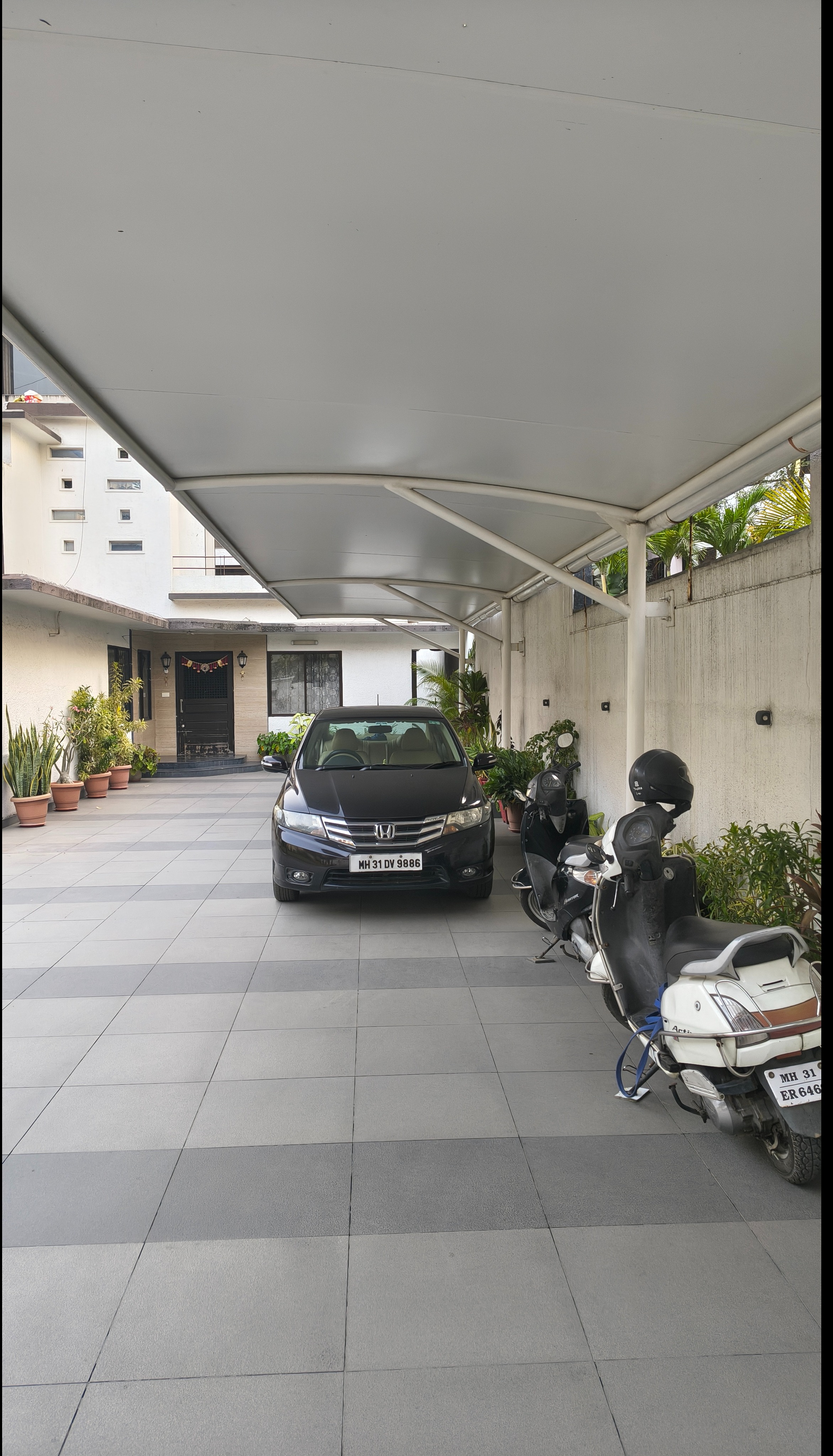
At FV INFRA LLP, we’ve been working to change that. We believe a hospital walkway shed Balaghat patients use should be more than just a roof—it should be a clean, bright, and watertight sanctuary.
The "Dry" Installation Advantage
One of the biggest headaches for a hospital administrator in Gondia or Bhandara is construction mess. You can't have cement dust flying around an ICU or noisy mixers running near a recovery ward.
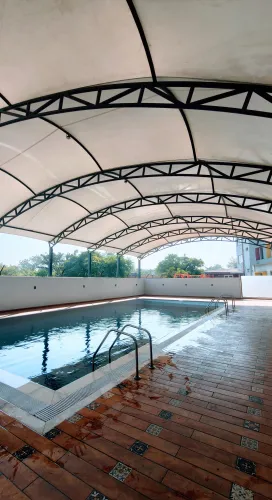
This is why a tensile structure Gondia medical campuses are now adopting is so brilliant. We do all the heavy lifting—the 3D designing, the structural drawings, and the fabrication—at our facility. When we show up on-site, it’s a "dry" installation. We can span hundreds of meters in just a few days without blocking hospital traffic or creating a cloud of dust. It’s fast, it’s clean, and it doesn't disrupt the life-saving work happening inside.
More Than Just Rain Protection
Let's talk about the "glow." If you’ve ever walked under a dark, dingy metal shed, you know how claustrophobic it feels. Our tensile membranes are naturally translucent. During the day, they filter the harsh Central India sun into a soft, diffused light. You don't need to keep the lights on under the walkway at 2 PM, which is a nice win for the hospital’s electricity bill.
Heat Reflection: These membranes block 100% of UV rays. Even in the 45°C heat of Nagpur or Chandrapur, it stays significantly cooler underneath.
Hygienic Surfaces: The fabric is smooth and self-cleaning. Rain naturally washes away the dust, and because there are no heavy internal pillars, there’s no place for birds to nest or for grime to collect.
100% Watertight: No leaks, no drips. Just a bone-dry path from the pathology lab to the main ward.
A Personal Commitment to Public Spaces
Every project we do across Maharashtra and Chhattisgarh feels a bit personal. We’ve taken our teams to Jabalpur, Akola, and Amravati, and even further out to places like Titlagarh and Ambikapur.
Knowing that our structures can stand up to extreme winds and heavy monsoons for 20+ years? Honestly, that’s what gives our team the most pride. It’s not just about medical campus roofing; it’s about making a difficult day a little bit easier for people who are already going through a lot.
Whether we are working on a massive clear-span area in Raipur or a narrow corridor in Gadchiroli, we handle everything from the first site visit to the final nut and bolt. We’re excited to keep modernizing these vital spaces, one walkway at a time.