
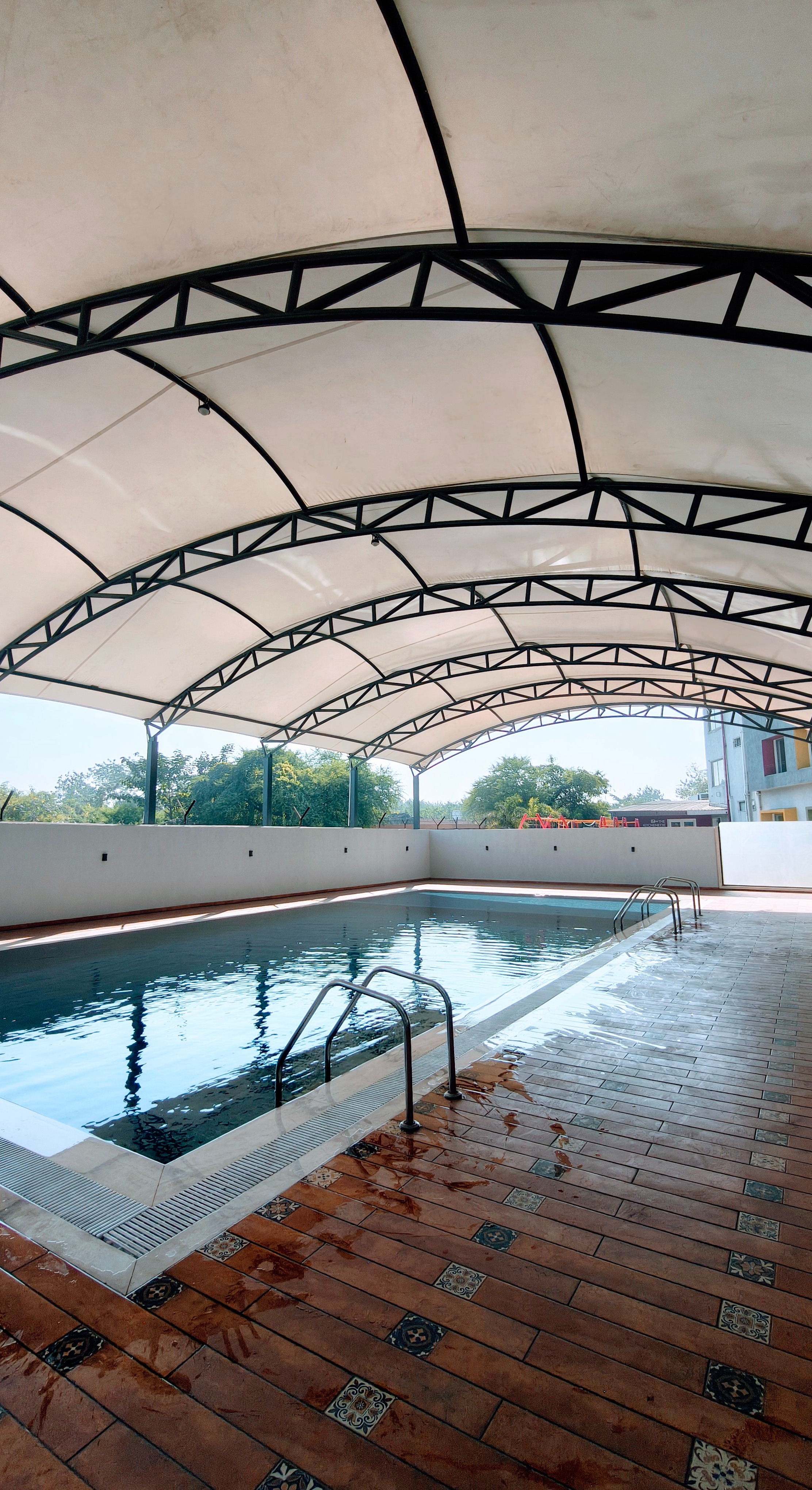
A few months ago, I was walking through the expansive healthcare campus of a major medical institute in Jabalpur. It was right at the tail end of our intense monsoon season. The administration had recently built a series of traditional corrugated metal walkways to connect the main emergency ward with the diagnostic labs. While the structures kept the rain off patients' heads, the overhead reality was unsettling.
Because of our high humidity and sudden temperature spikes, the metal undersides had already started trapping stagnant moisture. Dark green patches of moss and black mold fungus were forming along the joints, and a faint rust-orange discoloration was creeping from the bolt holes. For a retail market or a car park, it might just look ugly. But for a sterile medical facility handling recovering patients and vulnerable immune systems, airborne fungal spores and rusty surfaces are a genuine biological hazard.
Medical campus design requires an entirely different baseline of safety. Every square inch of an environment dedicated to healing needs to discourage contamination.
This is exactly why we are seeing forward-thinking healthcare administrators across the Nagpur-Raipur corridor move entirely away from rigid iron sheets. Instead, they are turning to high-performance, flexible membranes to protect their transit pathways.
The Science of Germ-Resistant Architecture
When we engineer a hospital walkway shed Jabalpur medical teams can trust, the secret isn't just in the strength of the frame—it's in the specialized chemistry of the surface layer.
Modern architectural fabrics use an advanced PVDF (Polyvinylidene Fluoride) top coating. This isn't just a basic laminate; it’s a chemically inert, ultra-smooth layer that changes how the roof interacts with the environment:
The Anti-Fungal Barrier: Unlike porous concrete or textured metal sheets, a premium hygienic tensile membrane has zero surface texture for microscopic spores to latch onto. Fungus, mold, and bacterial colonies cannot find a foothold on the inert material, preventing dangerous biological buildup completely.
True Self-Cleaning Action: The PVDF layer creates a highly slick, low-friction surface. When it rains in Madhya Pradesh, the water doesn't pool or collect into stagnant puddles. Instead, it beads up instantly and sheets off the curved canopy, naturally washing away dust, bird droppings, and atmospheric soot without requiring manual scrubbing.
100% Rust-Proof Longevity: Because the roof uses high-strength architectural fabric instead of interlocking iron sheets, it can never rust, corrode, or flake paint into the pedestrian pathways below—even after 20 years of exposure to chemical cleaners and intense weather.
Thermal Comfort for Vulnerable Patients
A busy medical campus means constant movement—wheelchairs moving between blocks, stretcher transfers, and families walking between buildings. During our brutal 45°C summers, traditional tin or fiber roofing sheds turn into intense heat radiators, creating a stifling, uncomfortable environment underneath.
Because advanced tensile fabrics are intrinsically bioclimatic, they actively reflect solar radiation and block 100% of harsh UV rays. The space underneath stays significantly cooler naturally. Furthermore, the natural translucency of the membrane allows soft, glare-free daylight to illuminate the path, creating a bright, calming, and stress-reducing walkway without relying on heavy artificial lighting grids.
Fast, Clean Setup with Zero On-Site Chaos
At FV INFRA LLP, we manage the entire execution lifecycle locally. We know that a hospital cannot simply shut down its ambulance bays or main driveways for weeks of messy on-site fabrication, heavy welding sparks, and concrete mixers.
Our end-to-end service model covers everything: from initial site inspections to custom 3D designing and rigorous structural drawings. Because all our steel frames and fabric sections are completely prefabricated in a controlled workshop, the on-site deployment is a quick, clean "dry installation" process. We can anchor and tension a massive clear-span structure over a driveway or path in just a few days, keeping the medical facility fully operational and free of dangerous construction debris.
We carry this high engineering standard across our core service areas in East Maharashtra, Madhya Pradesh, Chhattisgarh, Odisha, Telangana, and Rajasthan. Our installation crews are regularly on the road, delivering flawless canopy solutions to growing healthcare and commercial hubs in:
Madhya Pradesh & Maharashtra: Nagpur, Jabalpur, Akola, Amravati, Yavatmal, Bhandara, Gondia, Balaghat, Gadchiroli, Chandrapur.
Chhattisgarh & Odisha: Raipur, Bilaspur, Bhilai, Durg, Rajnandgaon, Ambikapur, Titlagarh, Kesinga, Kantabanji.
Ensuring a clean, sterile environment shouldn't stop at the hospital doors. By selecting smart, self-cleaning membranes for our outdoor architecture, we keep our community transit zones safe, bright, and completely hygienic from the very moment a patient arrives.