
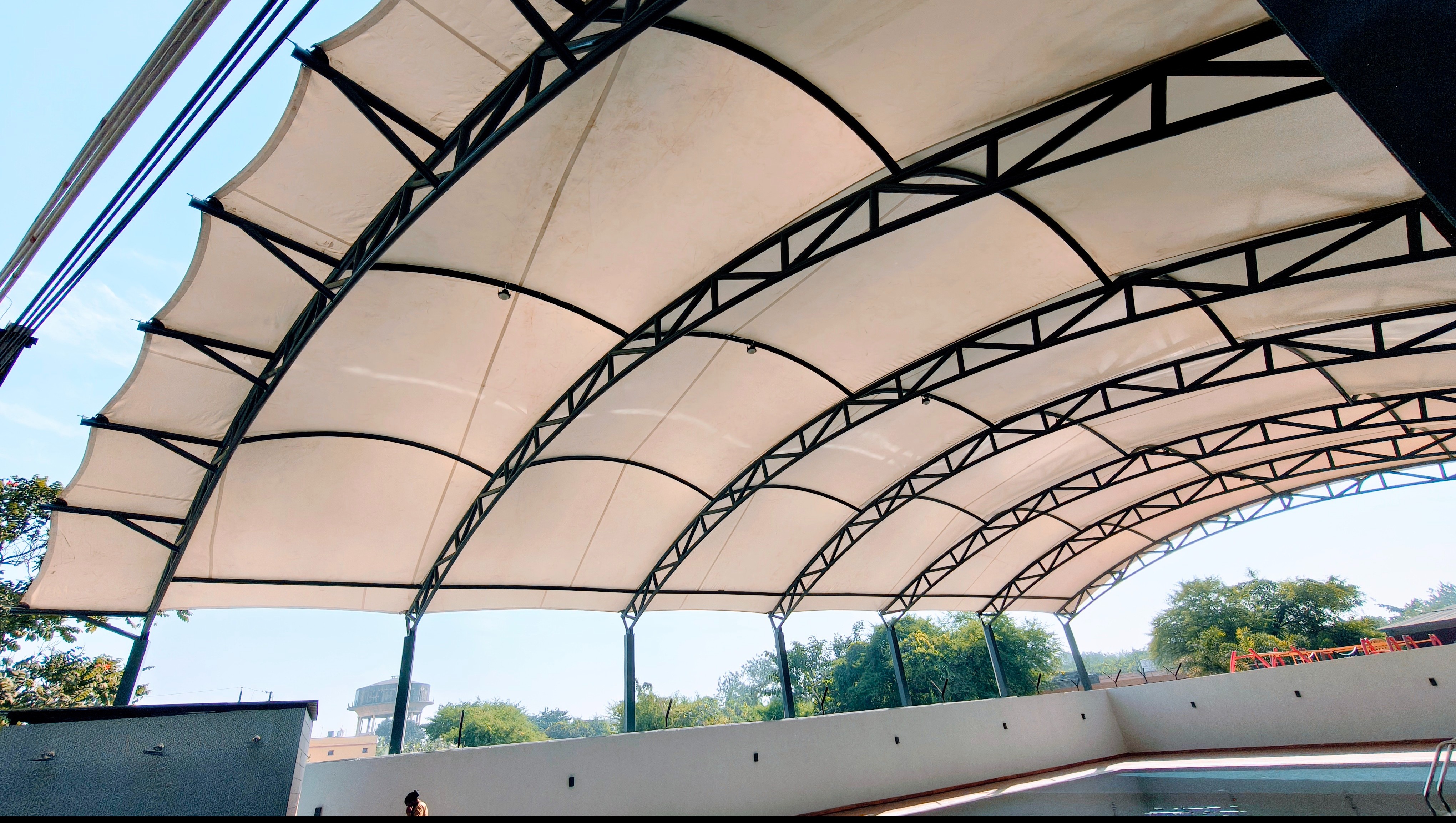
I was standing on a rooftop in Titlagarh last April, and I’m not exaggerating when I say I felt like I was standing on a giant frying pan. If you’ve spent even an hour in Odisha during the peak of summer, you know that the sun there doesn’t just shine—it punishes. I was meeting a developer who was building a new commercial plaza shed, and he was genuinely worried. "If I put a metal roof on this courtyard," he told me, "no one will stand here. It’ll be a furnace by 11 AM."
He was right. Traditional roofing in our part of the world—whether it’s concrete or tin—soaks up the sun and radiates that heat right back onto the people below. It’s why so many beautiful open plazas in places like Nagpur or Titlagarh end up deserted during the day.
At FV INFRA LLP, we’ve been working on a fix that feels almost like magic when you stand under it: high-albedo tensile structure Titlagarh projects.
The Science of Staying Chill
When we talk about "high-albedo," we’re just using a fancy term for how much sunlight a surface reflects. Our tensile membranes, usually made from advanced PVC or PTFE, act like a massive mirror for UV rays. Instead of absorbing the heat, the fabric bounces it back into the sky.
The 10-Degree Difference: It’s a strange sensation the first time you experience it. You walk from the blistering heat of the street under one of our structures, and the temperature instantly feels 8 to 10 degrees cooler. It’s a "bioclimatic" solution—nature does the work, so your AC bill doesn’t have to.
The Glow Factor: One thing I love about these Odisha projects is the light. In a metal shed, it’s dark and gloomy. With a tensile roof, you get this beautiful, diffused natural light during the day. At night? The fabric catches the plaza lights and creates this soft, "glow-in-the-dark" look that makes a commercial space feel premium and inviting.
Beyond the Fabric: The "Smart" Plaza
What’s really exciting lately—and something we’re seeing more of from Nagpur to Raipur—is the "Connected" element. We’re moving toward spaces that think for themselves.
We recently discussed a project where the client wanted the entire structure to feel like a living part of the building. People today want that "smart" integration. They want to be able to check their phone and see the roof status, or have sensors that detect a sudden Odisha monsoon and ensure everything is watertight before the first drop hits. While many of our large-scale heat reflective roofing Odisha setups are fixed for maximum wind resistance, the demand for automation is sky-high. It’s that blend of high-strength engineering and modern tech that really gets our team fired up during the 3D designing phase.
From Nagpur to the Edge of Odisha
We don’t just ship materials and hope for the best. We handle the whole messy journey so you don't have to. Whether it’s a site inspection in Jabalpur, a structural drawing for a mall in Bhilai, or a tricky installation in Kantabanji or Kesinga, we’re on the ground.
We’ve successfully finished projects in Amravati, Akola, and Yavatmal, and we’ve seen how these structures survive the brutal winds of Gadchiroli and Chandrapur. It’s what allows us to sleep at night—knowing that a structure we put up in Bhandara or Gondia isn't just beautiful, it’s earthquake-safe and built to last 20+ years.
Titlagarh is famous for its heat, but it doesn't have to be defined by it. By choosing the right "skin" for your building, you can turn a scorching courtyard into the most popular spot in town.