
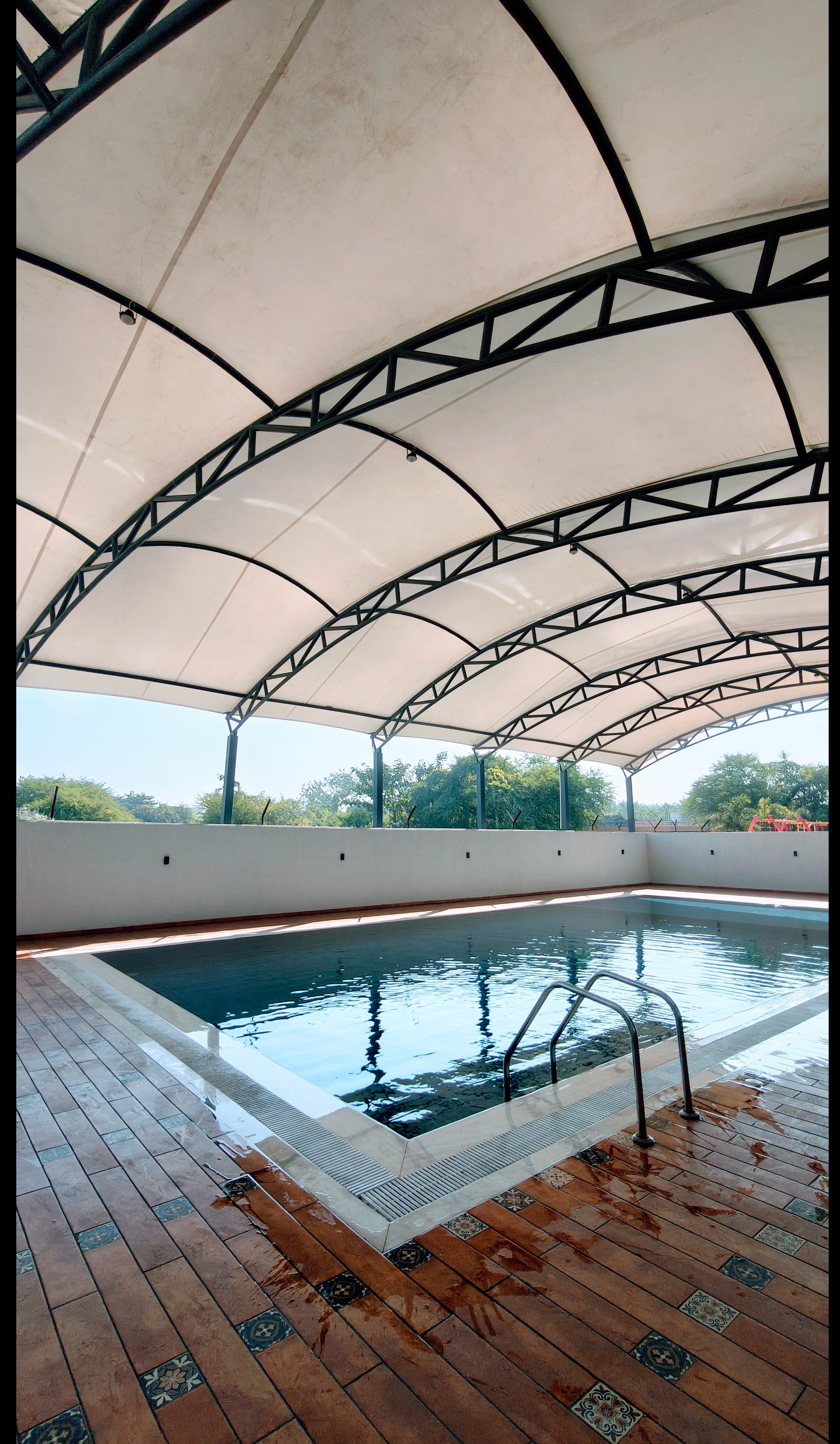
I was driving through a mining belt in Chandrapur last Tuesday, and the heat was doing that thing where it shimmers off the black earth. If you’ve spent any time there, you know it’s a place that asks a lot of its infrastructure. I passed a row of older steel sheds—rusted, rattling in the wind, and radiating heat like a giant toaster oven. It’s hard to watch workers or expensive machinery sit under those "ovens" when you know there’s a better way.
At FV INFRA LLP, we’ve been having some really interesting conversations with industrial site managers from Nagpur to Chandrapur. They’re tired of the "build-repair-replace" cycle. They need a heavy duty shed that doesn't just sit there but actually helps the site function. That’s where the shift toward industrial tensile structure Chandrapur projects is really picking up steam.
The "Self-Cleaning" Shield Against Coal Dust
One of the biggest headaches in a mining hub is the dust. It settles on everything, eats through paint, and starts the rusting process on traditional metal roofs almost immediately. But the advanced PVC and PTFE membranes we use are a different story.
The surface of a tensile roof is incredibly smooth. When it rains—or even if you just hose it down—the water beads up and washes the coal dust right off. It’s essentially a self-cleaning system. Because there’s no metal to corrode on the roof itself, you’re looking at a 20 to 30-year lifespan without the constant maintenance of an iron shed. For a mining site roofing solution, that’s not just a convenience; it’s a massive long-term saving.
Clearing the Floor: The "Clear-Span" Advantage
I remember a project in Gadchiroli where the manager was struggling with truck movement. His old warehouse was a forest of internal pillars. Every time a forklift driver turned a corner, it was a game of "don't hit the post."
Tensile structures work on tension, not just weight. This allows us to create massive, open spaces without a single pillar in the middle.
Truck Maneuverability: You get a wide-open floor for heavy machinery.
Bioclimatic Cooling: These fabrics reflect nearly all solar radiation. It stays significantly cooler underneath, which makes a huge difference for the health of your workers in that brutal 47°C heat.
Earthquake Safe: Because the membrane is so light, it requires less structural steel and handles seismic vibrations much better than a heavy concrete or metal roof.
A Personal Commitment to the Industrial Belt
Some projects just stick with you because they solve a real-world problem. We recently finished a loading bay cover in Chandrapur where the heat was literally stopping work mid-afternoon. We did the site visit and inspection, mapped out the 3D designing, and got the structural drawings done in record time.
Seeing that site become fully operational throughout the day, with the team working comfortably under a soft, diffused light, is what allows us to sleep at night. We’ve taken this same focus to Raipur, Bilaspur, Jabalpur, and even way out to Titlagarh and Kesinga. Whether it’s an industrial tensile structure Maharashtra relies on or a remote site in Odisha, we treat every bolt like it’s the most important one.
Fast Installation, No Mess
The beauty of what we do at FV INFRA LLP is that we don't turn your site into a construction zone for months. The components are prefabricated. When we show up on-site in Bhandara, Gondia, or Akola, we’re there to install, not to fabricate. Your space is usually ready to use in a matter of days.
If you’re managing a site in Wardha, Yavatmal, or Amravati and you’re looking at your old rusted sheds wondering how they’ll survive another monsoon, maybe it’s time for a change. We aren't just putting up a roof; we're building a "bioclimatic" shield that handles the unique grit and heat of our region.