
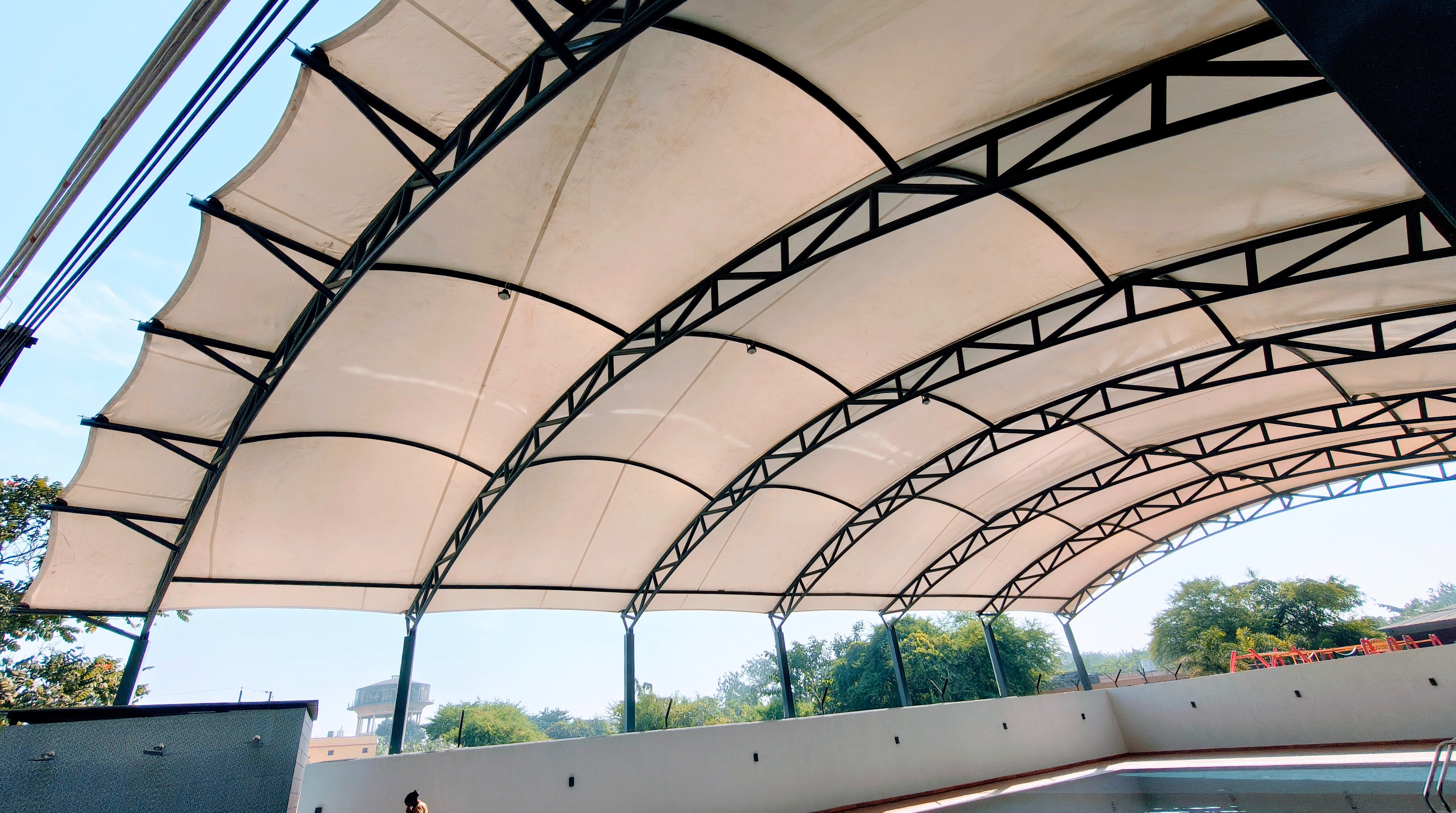
I was recently driving through Jabalpur, looking at some of the older public buildings, and it really hit me how much heavy concrete we’ve piled up over the years. Now, don't get me wrong, those structures have their place. But when you live and work in a city with Jabalpur’s specific seismic profile, you start to look at "heavy" in a completely different light. In a region where the ground can be unpredictable, every extra ton of concrete hanging over a public space is a liability we just don't need anymore.
It’s a conversation we’ve been having more frequently with planners from Nagpur to Bhilai. The shift toward lightweight tensile structure MP projects isn't just about looking modern or "fancy"—it’s actually a very grounded, safety-first decision.
The Safety Physics of "Lightness"
Here’s the thing about earthquakes: the more mass a roof has, the more force it generates when things start to shake. It’s basic physics, but it’s what allows us to sleep at night when we design for public spaces. By switching to a high-strength flexible membrane, we are essentially removing about 90% of the dead weight compared to traditional metal or RCC roofing.
If you’re looking at earthquake resistant roofing Jabalpur options, tensile structures are a game-changer. Because the fabric is under continuous tension and the overall mass is so low, the structure absorbs energy differently. It’s flexible enough to "dance" with the vibrations rather than resisting them until something snaps. It’s a sophisticated, "bioclimatic" way to protect people in stadiums, transport hubs, and parks.
Clear Spans and Public Logistics
Another challenge we were excited to take on recently involved a large public area where they needed massive coverage but couldn't afford to have pillars blocking the flow of people. With a traditional shed, you’re forced to plant heavy internal pillars every few meters to support the weight of the roof.
Tensile membranes don't work like that. Because they rely on tension, we can achieve these incredible, clear-span distances. This is perfect for public infrastructure roofing—think of a bus terminal in Bhilai or a community plaza in Nagpur where you need 100% weather protection without a forest of steel poles getting in everyone's way.
Built for the Central India Cycle
Beyond the safety aspect, we have to deal with the reality of our summers. A metal roof in May in Jabalpur or Durg is basically a giant radiator. It stays hot long after the sun goes down. But materials like PVC or PTFE reflect solar heat and block 100% of UV rays. The space underneath stays significantly cooler, and the natural translucency means you get this soft, diffused sunlight during the day—cutting down on the need for artificial lighting.
At FV INFRA LLP, we handle the whole journey—from the initial site inspection and 3D designing to the final on-site installation. We’ve been lucky to bring these iconic, curved designs to places like Amravati, Akola, and Bilaspur, and every project reinforces the same idea: you don’t need "heavy" to be "strong."
When we see kids playing under a massive, sun-drenched tensile canopy in a public park, knowing it's one of the safest places they could be if the ground ever shifts—that’s when the work really feels worth it.