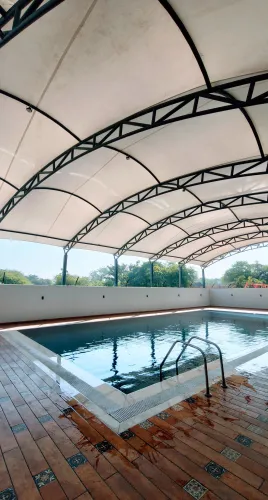
I remember walking through a heavy equipment storage depot just outside of Gadchiroli a couple of summers ago. The owner, a regular client who runs logistics along the active Nagpur-Gadchiroli industrial corridor, took me inside his main inventory shed. The heat under that traditional galvanized iron roof was absolutely punishing—it felt like stepping straight into a furnace. He tapped one of the metal structural pillars and showed me where the intense monsoon humidity had already started rusting the joints. "We are spending a fortune on patch-up welding and roof coatings every two years," he told me, wiping sweat from his forehead. "And our workers can barely stand to be in here past noon during May. There has to be a smarter way to protect a facility than just slapping down corrugated tin."
It’s an aggressive environment out here. The industrial and forest-heavy belts of East Maharashtra don't do things by halves. You either deal with blinding, skin-peeling summer sun or relentless, multi-day monsoon downpours that test the absolute limits of your infrastructure. For decades, standard metal sheets were the default choice for factory builds. But today’s plant managers are realizing that cheap iron is actually a massive long-term financial drain when you factor in thermal stress, rust maintenance, and lost productivity.
That is exactly why we are seeing a massive design pivot toward advanced PTFE membrane Maharashtra systems. Heavy industry is moving away from rigid, high-maintenance metal and embracing high-tension fabric engineering that completely shifts the rules of industrial shed durability.
Taming the Vidarbha Climate: The Fabric Revolution
When people think of fabric, they often think of temporary tents. But architectural PTFE (Polytetrafluoroethylene-coated fiberglass) is a completely different animal. It’s essentially a space-age material engineered to live exposed to the elements for decades without degrading.
Replacing heavy galvanized sheets with a tensioned membrane completely redefines how an industrial facility interacts with the weather:
The Heat Reflection Phenomenon: Unlike iron sheets that absorb solar radiation and transform into giant overhead heaters, PTFE actively reflects solar energy. It blocks 100% of UV rays, meaning the active workspace underneath stays significantly cooler naturally. Your ventilation systems don't have to work double-time, and your team can actually breathe.
The Power of Diffused Daylight: A metal roof throws a pitch-black shadow, forcing you to run high-wattage industrial lights even at noon. Advanced membranes are naturally translucent. They let a soft, perfectly even light filter through into the facility, lowering your electricity bills while eliminating the harsh glare that causes workplace fatigue.
A Self-Cleaning Freebie: The smooth, glass-like surface of these structures is fundamentally non-stick. When the heavy rains hit the region, the water doesn't pool or cause rust issues; it simply washes away dust, soot, and industrial debris naturally, keeping the roof immaculate with zero manual scrubbing.
Heavy Engineering Wrapped in a Smart Workspace
What makes this shift incredibly interesting is how modern infrastructure is taking cues from the residential "connected home" movement. Today, people are used to tapping an app or saying, "Alexa, open the pergola," to manage their personal spaces. In the commercial sector, managers want that exact same effortless, automated control over their macro environments.
We are increasingly integrating our heavy-duty industrial sheds with smart sensor networks. Imagine a massive, clear-span material yard where the canopy system works alongside automated weather trackers. If an extreme wind line-storm triggers alerts along the highway belt, the internal tensioning monitors can automatically adapt to handle the shifts in wind load, protecting your structural integrity without requiring a maintenance crew to scramble outside in dangerous conditions.
Clean Execution with No Operational Shutdowns
The part of this work that allows our team at FV INFRA LLP to sleep at night is the rigorous engineering that happens before a single piece of steel arrives at your site. Building a reliable long-life roofing Gadchiroli asset means skipping no steps. Our end-to-end service covers everything: a thorough localized site inspection, high-accuracy 3D designing, and detailed structural drawings to calculate wind-load drag down to the millimeter.
Because the steel frames and fabric patterns are entirely prefabricated in a controlled environment, the actual assembly on your property is a clean, dry process that wraps up in just a few days. You don't have to shut down your factory floor for weeks or deal with the messy chaos of traditional masonry construction.
We take this process incredibly personally, managing the entire supply and installation with our own specialized crews across Nagpur, Raipur, and Jabalpur. Whether we are tensioning a canopy for an engineering unit in Chandrapur or Akola, or setting up complex structures in Amravati, Yavatmal, Bhandara, Gondia, or Balaghat, we build for the long haul.
Seeing a pristine, iconic curved structure stand completely unfazed through the rough seasonal changes in Bilaspur, Bhilai, Durg, Rajnandgaon, or Ambikapur is what keeps us moving forward. We bring that exact same commitment to every project we deliver in expanding commercial zones like Titlagarh, Kesinga, and Kantabanji.
An industrial shelter shouldn't be something you worry about every monsoon. By switching to high-durability tensioned engineering, you get a beautiful, column-free, maintenance-free environment built to protect your business for the next 25 to 30 years.