
A few months ago, I was sitting in an administrator’s office at an engineering institute just outside Gadchiroli. Outside his window, a massive concrete canopy structure was being chipped away by jackhammers. It had developed deep structural fractures after a minor seismic tremor, and the sheer weight of the concrete was posing a genuine threat to the students walking underneath every day. He looked at the dust settling outside and told me, "We built this to last fifty years, but right now, looking at those cracks, I'm terrified of what happens if the ground moves again."
It’s a quiet concern that a lot of school boards and institutional heads across the Nagpur-Raipur corridor share, though few talk about it openly. Traditional metal trusses and heavy concrete roofs are incredibly rigid. When you are building public spaces or educational campuses in zones prone to shifting weather pattern pressures or tectonic tremors, that rigidity becomes a liability.
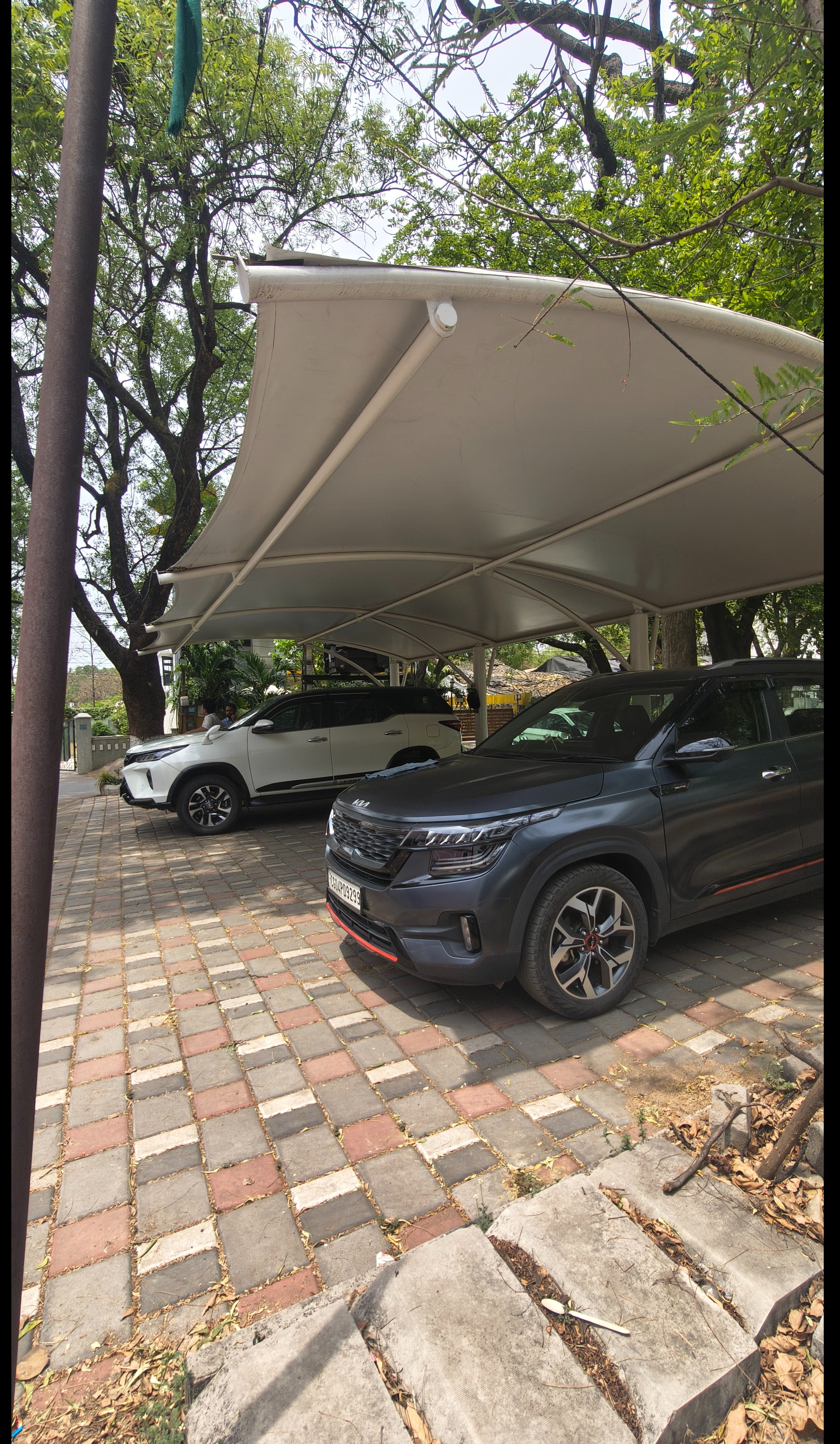
At FV INFRA LLP, we've been helping institutions rethink their campus layouts entirely by introducing high-performance, earthquake resistant tensile membranes. It's a fundamental shift from heavy, brittle building materials to flexible structural engineering.
The Physics of Safety: Why Weight Matters
When you think about an educational institution or a public center, safety is the one metric that isn't up for negotiation. The logic behind choosing a lightweight school shed over a conventional sheet roof boils down to simple physics: in a tremor, the less mass your roof has, the less kinetic force it exerts on the building supporting it.
Switching to tensioned fabrics completely alters the safety profile of a busy campus walkway or assembly area:
The Zero-Pillar Clear Span: Because these structures rely on continuous tension across a high-strength flexible fabric, we don't need a forest of heavy internal columns. You get a massive, completely open area that’s ideal for multi-sport courts, outdoor auditoriums, or massive car parks.
Earthquake-Safe Flexibility: A PVC or PTFE membrane doesn't crack, shatter, or snap when the ground moves. It flexes naturally with the steel skeleton underneath, absorbing structural stress rather than resisting it until it breaks. For any facility director looking for reliable safe roofing Gadchiroli options, it offers absolute peace of mind.
Beating the 45°C Classroom Heat: Conventional metal sheets turn an outdoor seating area into a radiator by noon. Our architectural membranes block 100% of harsh UV rays and reflect solar heat. It keeps the ground below significantly cooler, while its natural translucency allows soft, diffused daylight to filter through so students aren't left sitting under a dark, gloomy awning.
When Public Infrastructure Connects to the Future
The push for safer structural design is happening right alongside the rise of the smart, "Connected Home." We’re all used to residential clients who expect their spaces to be intuitive—people wanting to say, "Alexa, open the pergola," or expecting their patio covers to automatically roll shut when they leave for the office.
We are bringing that exact responsive philosophy into large-scale institutional projects across Maharashtra and Chhattisgarh.
We’ve started integrating smart automated sensor arrays directly into our institutional structures. Imagine a massive school assembly canopy or a transit walkway between campus blocks that monitors local weather data in real-time. If a sudden, extreme wind storm rolls through Raipur or Jabalpur, or if heavy monsoon downpours strike Akola and Amravati, the structure can dynamically adjust its own internal cable tension or deploy integrated wind breakers automatically. The architecture protects the crowd before the maintenance team even has time to locate the control panel.
Handled Locally, Built to Last
We don't believe in dropping off pre-made fabric templates and leaving the heavy lifting to local contractors. We handle every detail ourselves—from the initial site visit and 3D designing to the exact engineering calculations in the structural drawings before a single piece of steel is cut.
We’ve watched these structures transform communities in places like Chandrapur, Bhandara, and Gondia, where heavy rains test your roof every single year. I remember a challenging installation we did for a community center out in Yavatmal where the wind speeds were notorious. Getting that fabric tensioned perfectly so it was completely watertight, watching the rain wash the dust off naturally during the next monsoon... that’s the part of the job that makes the long drives across Balaghat, Bilaspur, and Bhilai worth it.
Whether we are working on a commercial hub in Durg and Rajnandgaon, an institutional center in Ambikapur, or expanding our reach into Titlagarh, Kesinga, and Kantabanji, we build with the understanding that a roof is a long-term investment. It should look like an iconic piece of modern architecture, it should require zero maintenance for 20 years, and most importantly, it should keep the people underneath it safe.