
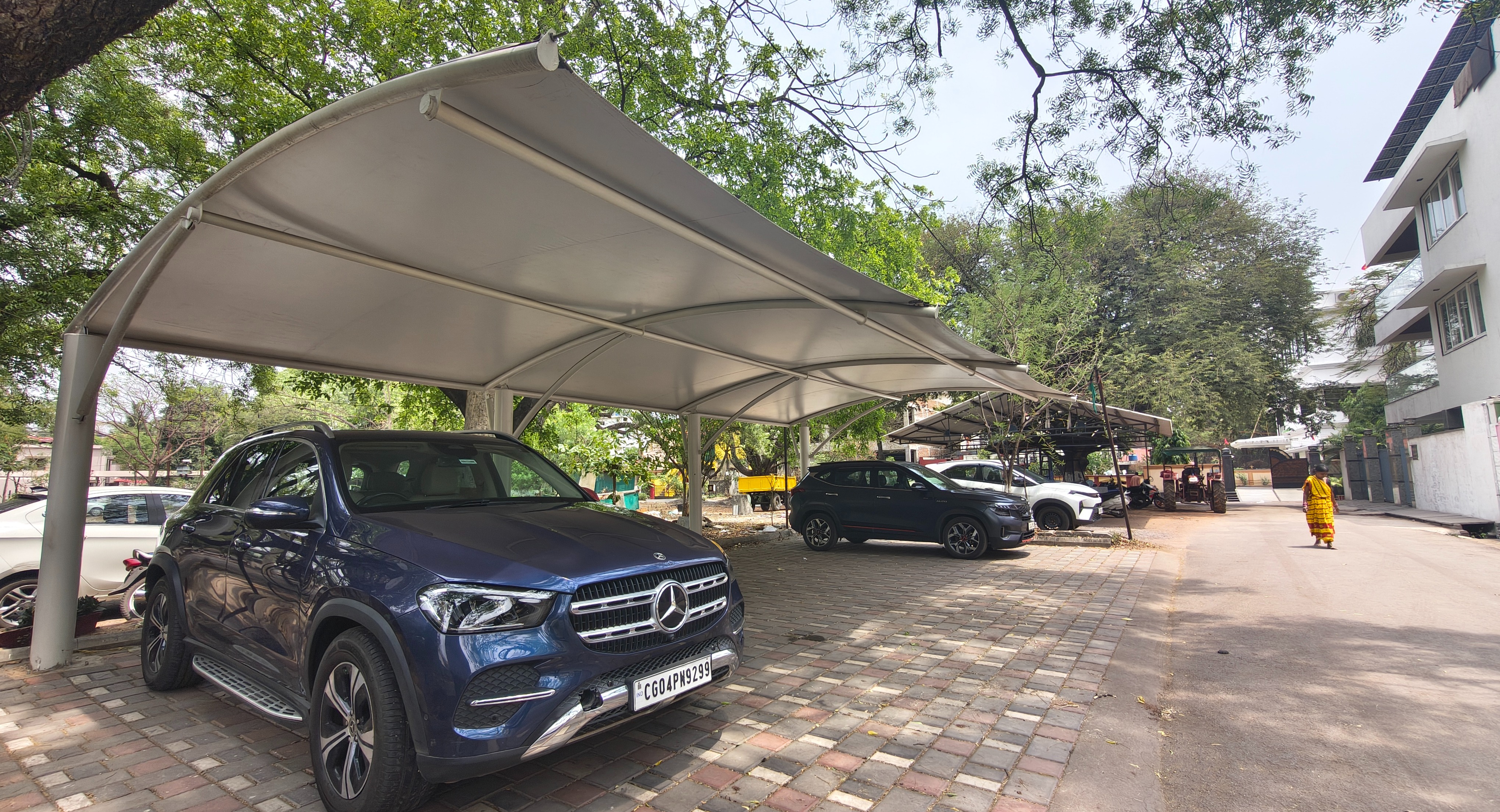
I was walking through a prominent university campus in Raipur last August—right in the middle of one of those classic Chhattisgarh cloudbursts. I watched a group of students, laptops tucked under their shirts, making a desperate, soaking-wet dash from the main library to the cafeteria. A faculty member standing near me sighed and said, "We have these beautiful, world-class buildings, but for three months of the year, they might as well be on different planets because nobody can move between them without getting drenched."
It’s a gap in campus planning we see all the time. We build the "destination" but forget the "journey." That conversation stayed with me because it’s exactly the kind of problem we started FV INFRA LLP to solve. When we talk about a university walkway shed Raipur project, we aren’t just talking about putting up a few poles and a roof. We’re talking about creating a cohesive, "connected campus" where the weather stops being an obstacle to education.
From Blueprint to "Bone-Dry"
What makes our approach different is that we don't believe in "off-the-shelf" solutions. Every campus has a different heartbeat, a different wind flow, and a different architectural language. We handle the entire journey ourselves—it’s that end-to-end service that really lets our team sleep at night, knowing we controlled the quality from the first bolt to the last inch of fabric.
The 3D Vision: We start with a site visit and inspection to see how students actually move. Then, our 3D designing phase shows the university board exactly how a tensile canopy Chhattisgarh sun won't penetrate will look against their existing stone or brickwork.
The Engineering: Our structural drawing team ensures these aren't just pretty shapes. These membranes are pulled under massive tension to be 100% watertight. No sagging, no pooling, and no "drumming" noise when the rain hits.
The Install: Because we prefabricate the steel and the PVC/PTFE membranes, we aren't turning the campus into a construction zone for months. We’re usually in and out in days, meaning classes aren't disrupted.
Why Tensile is the New Campus Standard
I’ve had administrators ask me, "Why not just build a concrete corridor?" The answer usually becomes clear the first time they stand under a finished tensile structure during a 44°C Raipur afternoon.
Concrete and metal absorb heat. They turn into radiators. But the advanced membranes we use reflect solar heat and block 100% of UV rays. It’s a "bioclimatic" fix. The air underneath is significantly cooler, and the natural translucency of the fabric means you don’t need to keep the lights on during the day—the sun provides a soft, diffused glow that feels much more natural than a dark, heavy tunnel. It’s a modern corporate architecture feel brought to an educational campus roofing project.
A Personal Commitment to the Region
Some projects just stick with you. We recently finished a walkway in Bhilai where the path curved around some old-growth trees the university didn't want to cut down. We were excited to take on that challenge. We designed a "wave" form that snaked around the branches, protecting the students while respecting the greenery. Seeing the students sit under it between classes, actually using the walkway as a social space... that’s the win.
We’ve carried this same obsession for detail to Nagpur, Jabalpur, Akola, and Amravati, and even out to places like Titlagarh, Kesinga, and Gadchiroli. Whether it’s a car park tensile structure in Chandrapur or a massive entrance in Durg or Rajnandgaon, we take it personally. We’re not just supply and installation; we’re part of the city’s growth.
The 30-Year Promise
If you’re managing a campus in Bilaspur, Bhandara, or Gondia, you know that maintenance is a budget-killer.
Self-Cleaning: The smooth surface of our membranes means the rain actually does the washing for you. Dust from the Raipur plains just slides off.
Zero Rust: We use high-grade, powder-coated steel. No repainting every three years.
Earthquake Safe: Because the structures are so lightweight, they are inherently safer than heavy concrete or metal sheds.
We aren't just selling a "roofing shed"; we’re helping universities build a smarter, cooler, and drier future for their students.